

This month I gave a keynote at Courage26, the annual gathering of encourageventures at the Mercedes-Benz Museum in Stuttgart. I was there as this year’s winner of Business Angels Europe’s Golden Aurora Award, speaking to a room full of women investors and founders about the part of the startup story we talk about least: what happens between founders and investors after the money arrives.
I told it as a love story. The dating, the proposal, the pre-nup, the wedding, and the very real risk of a messy divorce. It got a lot of laughs. It also started some very honest conversations afterwards, which is exactly what I hoped for. So here it is, written up for everyone who wasn’t in the room.
First, who am I to talk about relationships?
I’m not a billionaire. I’m not even a millionaire. But I am an angel investor, and before that I was a tech founder five times over.
I founded three of those companies with my husband, and we are still married. I have been a female tech founder poster child. I have also been fired as CEO by my own investors, and became a cautionary tale for how to fail spectacularly. For about a year nobody invited me to anything, in case my failure was catching. But I got up and did it again, determined to make new mistakes.
Along the way I’ve raised money from pretty much every early stage source there is, including non-dilutive funding (aka revenue and grants!), which I particularly favour. I’ve even watched people who once worked for me go on to found startups of their own. It is a long game, played across multiple companies, and your network and your resilience matter more than any single round.
Why I invest
Money is power. And the problems women care about will only get solved when women investors fund women founders.
I typically invest around €5,000 of my own money at a time. Mostly locally, in diverse founders building businesses with positive social impact, in problem spaces and sectors I understand. I do it because I love founders, because it’s fun, and because it is a lot easier to invest in a startup than to found one.
So here is my challenge to women. If you can afford to spend €3,000 on a handbag or a coat, you can afford to invest €3,000 in a startup. Just understand there is a very high risk the handbag will last longer than the startup. Do it anyway. It is rewarding, you can genuinely help, and I believe we have a moral obligation to bring hope and jobs back to our communities.

Let’s talk about dating
So you’re thinking about dating. How do you start, and how do you avoid losing all your money to a desperate founder? Or, if you’re the founder, your time, energy and company to a problematic investor?
Investors, start small. Ticket sizes of €3,000 to €5,000 are absolutely fine, and several small deals are better than one big one. Don’t blow your entire budget on the first date either. If it goes well, you will probably want to follow on, and there will be more dates. Join a network, because no one individual is smarter than the group. Have an investment thesis and use it as a filter.
Founders, don’t be transactional. Angels are not credit cards with legs. Be discerning, because not all money is the same, and angels are not VCs with less money.
And everyone, avoid being swept away by hormones. I am always falling in love with founders. I have to build in thinking time, and listen to the less excited views of my fellow angels. If you’re new to angel investing, joining a network and their screening committee is one of the best things you can do.

Getting to “I do”
Maybe you’ve found the one. Before we talk about divorce, how do you get to yes?
Don’t propose in the first minute of the first date. Don’t open with “Will you marry me?” Open with “Can I send you my pitch deck?”
Yes is not one big moment. It is a series of little yesses, each one a little commitment leading to the next step. The sift, the screening, the pitch, the follow-up questions, agreeing where to send the money, and then the follow-on round. Every step is a chance for it to go wrong, or a chance to build trust.
This is where a network really earns its keep. It gives you shortcuts to trust, and helps you spot the dinosaurs, the snakes and the frogs early, before you waste time and lose perspective. Dinosaurs are big and slow, so they’re pretty easy to avoid. Whereas snakes can sneak up and kill you. And don’t believe all that stuff about kissing frogs to find your prince. If you really want funding from a prince or a princess, I would suggest you don’t start by looking in a pond.
Founders, choose your funding path carefully. Avoid the distracting lure of VCs unless you are truly a VC-shaped business.
Investors, be clear about what you bring. I always set out my why, I ask founders to consider me as an investor, and spell out my reporting expectations up front. I also tell them not to expect me to fill their round on my own. If they work with me as a champion I can and will help, far beyond my ticket size. A small cheque from a high value investor, such as an exited founder, can be disproportionately impactful.

Don’t skip the pre-nup
Founders, read the term sheet. The biggest valuation is not always the best deal. Look closely at vesting terms, voting and information rights, any preference stack and advisory fees.
Angels, understand your rights as an investor too, from reporting to pre-emption. This is the conversation to have while everyone is still in love, and we all still remember that commitment is a two-way process.
Yes is only the beginning
Founders, the wedding is over and now the cash evaporates quickly and the real work begins. Use your investors as champions and door openers. Just don’t invite them to second guess every decision.
Investors, this is where you see who you really married. Good founders establish a reporting cadence and ask for specific help and input. Bad founders go silent until they want more money. Work on listening and communicating, and don’t tolerate game playing or time wasting.
Things will go wrong. That is expected. Where you stand out, and where you can be a force for good, is in how you communicate and manage it. Report in good times and bad. Please tell your investors about problems early, and not by changing your LinkedIn status to “Found a new job”. Investors, don’t panic at the first bump in the road. This is likely a decade long process, or more!
Reporting matters to me because I want to be useful, and my money is the least interesting thing about me. I can only help if I know what is going on.
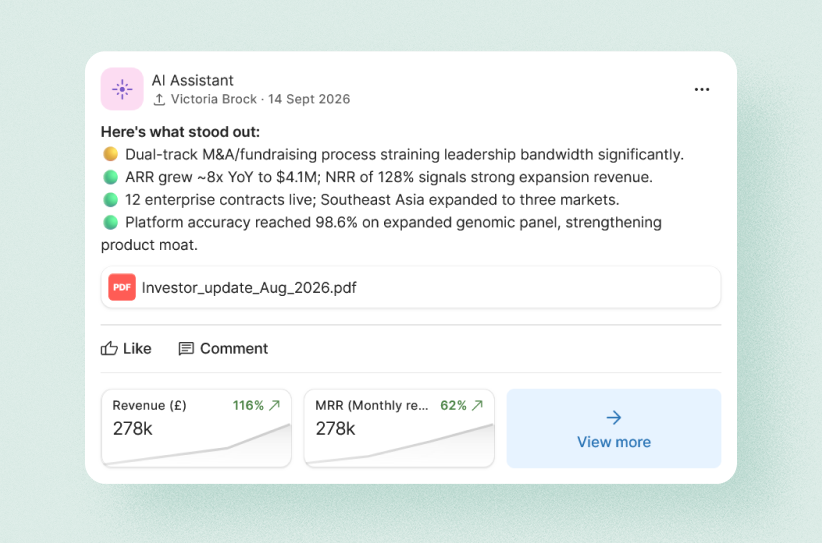
I also make it as easy for founders as I possibly can. I manage my own portfolio in Investor Plus from Dealum, and all a founder needs to do is email or WhatsApp me their update. Investor Plus does the rest. It reads the update, pulls out what stood out, from runway to revenue, and keeps a clear view across my portfolio of who is flying and who needs attention. When a founder goes quiet, I notice. When they need help, I can see it early enough to be useful.
What does a happy ending look like?
Exits. What is good for founders is generally good for angels, because we usually invest on the same terms. We all need an exit. But if the cap table has been looked after, a modest exit that a VC would never accept can be life changing for founders and angels alike. It also lets the angels keep up their expensive investing habit.
Good exits are rare, though. That is why it is essential to learn the art of the emergency stop. A controlled stop, where nobody gets hurt, means founders and investors can work together again and again.
Then there are the lose-lose messy divorces. Everyone loses money, nobody speaks to each other, and the whole ecosystem is a little poorer for it. Those are the ones we should all work hard to avoid.

Here we go again
This is a long game. You will fail. Fail fabulously, learn, and go again.
Diverse decision making delivers better returns. And by funding founders, we get to decide which problems get solved in society. Money is independence. Money is power.
So founders, when your time comes, keep that money in your ecosystem and back the next generation. And investors, start small, invest with others, and keep talking to each other. That is how you avoid the messy divorce.
Thank you to encourageventures for having me at Courage26. If you’d like to talk about angel investing, or about bringing this talk to your own network, email me at victoria@dealum.com or find me on LinkedIn. And if you’d like to see how Investor Plus could help with your own portfolio, start a free trial.